Global benefits insights: October 2026
A summary of the latest employee benefits changes from around the world | 5 minute read
Canada
Québec increases tax on insurance premiums1
Effective from 1st January 2027, the insurance tax rate will increase.
The QST (Québec Sales Tax) rate is currently 9%. Taxable premiums paid on or after 31st December 2026 will be subject to the new rate of 9.975%.

India
Increases EPF Wage ceiling2
The Union Cabinet in India has approved an increase in the wage ceiling applied to Employee Provident Fund (EPF).
Effective from 17th September, the salary ceiling used will increase from INR 15,000 to INR 25,000.

Mauritius
Expands leave provisions3, 4
The Economic and Financial Measures (Miscellaneous Provisions) Act 2026 introduces amendments to the WRA that are effective from 1st January 2027.
The act provides the following enhancements:
Maternity leave
Leave is extended to 12 months: six months at full pay, followed by an optional six months at half pay. Previously, only four months were paid.
Paternity leave
Leave increases from 4 to 6 weeks.
Menstrual leave
Women experiencing severe symptoms are now entitled to one day of paid leave each month.
Public holidays
Public holidays that fall on a Sunday will now be observed the following Monday.

South Africa
Announces additional public holiday5
4th November 2026 will be observed as a nationwide public holiday.
President Cyril Ramaphosa announced the additional holiday for the local government elections. Public schools will also be closed that day.

United Kingdom
Introduces statutory bereavement leave6
From April 2027, employees who experience a bereavement will be entitled to unpaid leave.
Employees may take up to two weeks’ leave following the death of a spouse or partner, parent, adult child or sibling. This includes step, half and adopted siblings, as well as siblings in kinship or foster care.
Women and their partners, including biological or intended parents and those in surrogacy arrangements, will also be entitled to two weeks’ bereavement leave following pregnancy loss before 24 weeks’ gestation. This covers miscarriage, termination and unsuccessful IVF transfer.

South Korea
Increases paid fertility leave7
From 27th November 2026, the paid entitlement for infertility treatment leave will increase.
Employees undergoing fertility treatment are entitled to six days’ leave, of which two are currently paid. The paid entitlement will increase to four days, while the maximum wage cap will rise from KRW 168,420 to KRW 336,840.

El Salvador
Mandates annual bonus payments8
From 1st January 2027, qualifying private-sector employees must receive an additional mandatory bonus.
Previously limited to public-sector employees, the bonus will now extend to the private sector. Employees must earn at least USD 1,500 per month and have at least one year’s service by 12th December of the previous year. The bonus, equal to 50% of gross monthly salary, must be paid between 15th and 25th January 2027.

Bahrain
Introduces mandatory medical cover for expats9
From 31st October 2026, expatriate employees will be covered by the National Health Insurance Programme under a ruling by the Supreme Council of Health.
Expatriate employees will have access to the SEHATI healthcare system, covering primary and secondary care, emergency treatment and accidents.

Minimum wage increases from 1st October 2026
Argentina
The monthly minimum wage will increase over the next few months to the following:
- October 2026 – ARS 391,200
- November 2026 – ARS 398,800
- December 2026 – ARS 406,400
- January 2027 – ARS 414,200
- February 2027 – ARS 422,00010
Geurnsey
From 1st October 2026, the hourly minimum wage will rise to GBP 13.10 for employees aged 18 and over, and GBP 11.80 for those aged 16 or 17.11
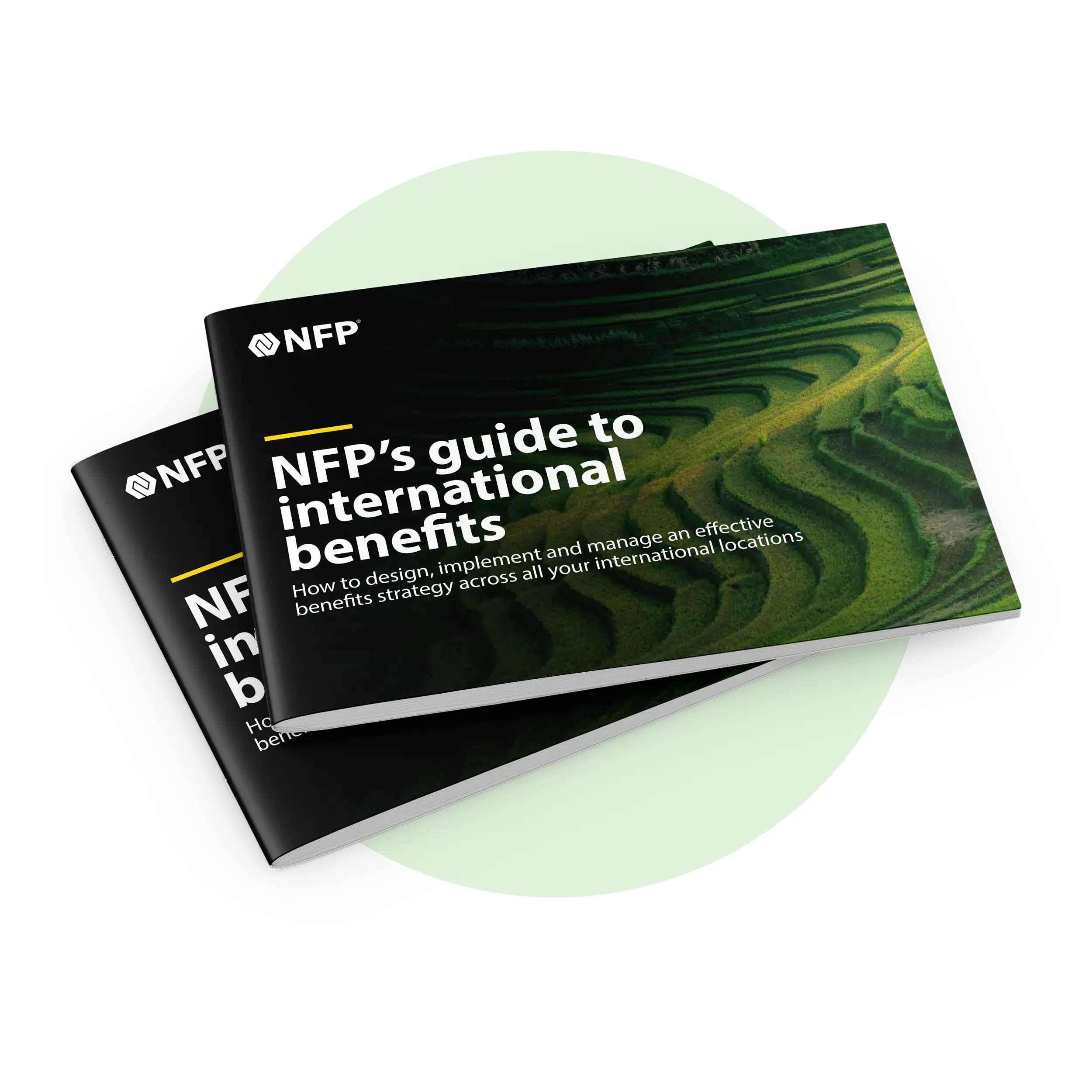
NFP’s guide to international benefits
Whether you’re a new start-up, a growing enterprise or an established international organisation, operating globally comes with its own set of unique challenges; from navigating legal and tax legislation to understanding local cultures, creating compliant and competitive benefits packages can be complex.
Our team of experienced international employee benefits consultants have written this guide to help you:
- Achieve consistency in your international benefits strategy
- Identify benefits to implement in each of your locations
- Choose the right international benefits providers
- Manage your international benefits efficiently
- Monitor your strategy’s success
Here to help...
If you’d like to explore how these legislation changes could affect your organisation, and what practical steps you can take to protect and support your people - speak to us today.
General disclaimer
This insights article is not intended to address any specific situation or to provide legal, regulatory, financial, or other advice. While care has been taken in the production of this article, NFP does not warrant, represent or guarantee the accuracy, adequacy, completeness or fitness for any purpose of the article or any part of it and can accept no liability for any loss incurred in any way by any person who may rely on it. Any recipient shall be responsible for the use to which it puts this article. This article has been compiled using information available to us up to its date of publication.
NFP contributors
Emma Bryant
International Technical Specialist, Employee Benefits
https://www.nfp.co.uk/insights/articles/global-benefits-insights-october-2026/
2026 Copyright | All Right Reserved
2026 Copyright | All Right Reserved